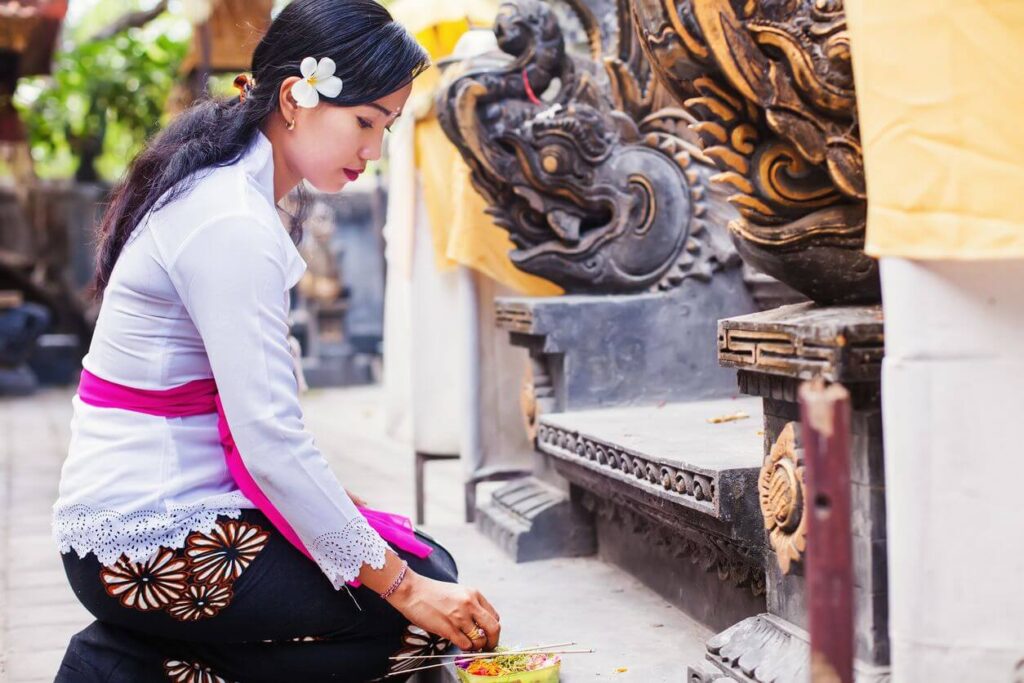
Visiting a temple in Bali is not quite like visiting a monument.
The gates may be open, and visitors may be welcome, but these are first and foremost places of worship, spaces where Balinese families come to pray, bring offerings and take part in ceremonies that have been observed for generations.
Some of the island’s most important temples are now firmly established on the tourist trail. Yet understanding a little of what happens beyond their gates can transform the experience entirely.
You don’t need to know every ritual or religious tradition before entering. A few essential points, and a willingness to observe, go a long way.
Dressing for a temple visit
A sarong is part of the customary dress for entering most Balinese temples, for both men and women, usually worn with a sash around the waist.
Many of the better-known temples provide or rent them at the entrance, although requirements vary from place to place. If your day includes several temple visits, carrying your own can simply make things easier.
Shoulders and upper body should also be appropriately covered. Bali may be wonderfully informal in many respects, but what feels perfectly natural at a beach club or by the pool is not necessarily appropriate in a sacred space.
Think less in terms of a dress code and more in terms of the place you are entering.
Understanding the space around you
A Balinese Hindu temple, or pura, is usually composed of a series of courtyards, leading gradually from the outer areas towards the most sacred inner spaces.
Not all of them are necessarily open to visitors.
Access can also change during religious festivals and ceremonies. A courtyard that is normally accessible may temporarily be reserved for worshippers, while a seemingly quiet temple can suddenly become the centre of village life.
Signs and barriers should of course be respected, but so should the subtler cues around you. In Bali, taking a moment to observe before moving forward is often the best guide.
When you encounter a ceremony
Ceremonies are woven into everyday life in Bali. This means you may arrive expecting a quiet temple visit and instead find families in ceremonial dress, elaborate offerings, music and hundreds of worshippers.
It can become one of the most memorable moments of a journey.
The important thing is to remember that you are witnessing a religious occasion, not a performance arranged for visitors.
Give processions room to pass and avoid moving between worshippers and the shrine or priest towards whom their prayers are directed. Be particularly mindful of offerings placed on the ground.
And if you are unsure whether you should enter a particular area, simply ask. A little curiosity combined with respect will take you much further than trying to memorise a long list of rules.
Photography and knowing when not to take the picture
Photography is permitted in many Balinese temples. That does not mean every moment needs to be photographed.
Temple architecture, carvings and gardens naturally invite the camera. A person absorbed in prayer is different.
Ceremonies, blessings and moments of personal devotion deserve more discretion. Avoid flash and never step into a ritual space or interrupt what is happening for the sake of a better angle.
Some of the most meaningful moments in Bali are better experienced without a screen between you and what is happening.
Small gestures matter
Respect in a Balinese temple often comes down to details.
Avoid standing directly in front of someone who is praying or positioning yourself above a priest conducting a ceremony. Temple walls, shrines and religious structures should never become platforms for photographs.
It is also worth watching where you walk. Small daily offerings, known as canang sari, are an integral part of Balinese spiritual life and are often placed around entrances and pathways.
You will see them everywhere on the island. Stepping around them rather than over them is a simple gesture of awareness.
Understanding temple restrictions
Some temples have specific restrictions connected to traditional Balinese Hindu concepts of ritual purity. Depending on the temple, these can relate to menstruation, recent childbirth, bereavement or other circumstances.
For international visitors, some of these traditions may be unfamiliar. They are nevertheless part of the religious customs of the place you are entering.
There is no need to arrive with an encyclopaedic knowledge of temple protocol. Rules can differ, so the most respectful approach is simply to follow the guidance provided at each temple.
The meaning behind the sarong
The sarong is more than something required at the entrance.
Wearing one acknowledges that you are entering a sacred space. The same principle applies when visitors are invited to wear traditional Balinese clothing for a ceremony or spiritual experience: understanding why you are wearing it adds another layer to the experience.
It is a small distinction, but an important one. Cultural traditions become far more interesting when we understand their meaning rather than simply reproducing their appearance.
This idea is also central to Conscious Travel in Bali: The 5 C Principles Behind a Better Trip, approaching a destination with curiosity and respect rather than simply consuming what we see.
When a guide adds something more
You certainly don’t need a guide every time you visit a temple.
Many can be explored independently, particularly when the architecture, setting or landscape is the main reason for visiting.
But there are places, and moments, where local knowledge changes the experience completely.
Why does one shrine face towards the mountain? What do the different offerings represent? Why are people gathering in one courtyard rather than another? What is happening during the ceremony you have unexpectedly encountered?
A good guide gives you more than dates and names. They give you context.
And context is often what turns a beautiful place into something you will remember.
If temples form an important part of your itinerary, Bali Travel Mistakes: What Most People Get Wrong (and How to Avoid Them) also looks at another side of planning: why geography, traffic and timing matter just as much as choosing where you want to go.
Choosing which temples to visit
There are thousands of temples across Bali. Seeing more of them does not necessarily mean understanding more of the island.
Some are extraordinary for their architecture; others for their setting, history or spiritual importance. And occasionally, a small village temple discovered along the way, or a ceremony you never expected to encounter, stays with you longer than one of Bali’s most photographed landmarks.
Rather than building an itinerary around a list of “must-see” temples, choose the places that add something to the journey you are already making.
In East Bali Travel Guide: Sidemen, Temples, and a Slower Side of the Island , for example, we explore how temples become part of a wider journey through the landscape, villages and culture of eastern Bali rather than isolated sightseeing stops.
Enter as a guest
Perhaps this is the only rule worth remembering.
You do not need to understand everything you see. You do not need to know the meaning of every offering or every gesture.
Observe before stepping forward. Ask when you are unsure. Give worshippers space. And allow yourself to experience the temple as something more than another place on the itinerary.
Bali becomes far more interesting when its sacred spaces stop being simply things to see and begin to reveal something about the culture that created them — and continues to give them meaning today.
Explore Bali with us
At Take Me to the Moon, we design personalised journeys that connect Bali’s temples, landscapes, communities and experiences in ways that make sense geographically, culturally and personally.
Because sometimes the difference between visiting a place and truly experiencing it is simply understanding what you are looking at.
Get in touch and tell us about the journey you have in mind.
Or explore our curated experiences across Bali and beyond.